Understanding Door Mechanics and Hardware Compatibility in Kings Somborne
Kings Somborne features a broad variety of architectural styles, from historic timber-framed cottages to modern residential developments across the Test Valley. Across these properties, an entrance door functions as an interconnected mechanical assembly rather than an isolated lock. When a key resists turning, a handle sags, or a latch catches against the frame, the underlying fault often originates outside the lock cylinder itself. Diagnosing how hinges, frames, strike keeps, and internal gearing interact is an essential first step before adjusting fittings or purchasing replacement hardware.

How Operating Forces Interact Across the Door, Frame, and Hinges
Entrance mechanisms depend on precise operational tolerances between the movable door leaf and the static frame. Over time, subtle foundation settling or hinge wear can cause a door leaf to drop slightly within its opening.
Why can a key turn smoothly when the door is open but resist when closed?
When an entrance door stands open, latch bolts and multi-point locking pins extend into open air without obstruction. Once the door is closed, any minor vertical drop or lateral displacement forces those moving parts to grind directly against the frame keeps. This physical friction creates substantial resistance, making the key or handle feel jammed. Testing key rotation with the door open immediately reveals whether the mechanism has suffered an internal failure or if the door leaf simply requires hinge realignment.
Distinguishing Component Wear from External Mechanical Resistance
Identifying which section of an entrance system is malfunctioning prevents unnecessary hardware expenditure. Modern doors separate mechanical duties across three distinct components: the key cylinder (which validates the key), the lock case or central gearbox (which drives latch and bolt movement), and the perimeter linkages and strike keeps.
A cylinder fault is typically indicated when a key catches during insertion, binds even while the door is open, or spins freely without throwing the latch. Conversely, if a door handle droops noticeably below horizontal, or if multi-point hooks fail to project despite smooth cylinder rotation, internal springs or drive teeth within the gearbox are likely worn. Continuing to force a stiff handle or binding key places heavy stress on these components, which may shear the key blade or strip internal drive gears.
Dimensional Criteria That Determine Replacement Hardware Fit
Replacement security hardware must match existing door preparations, as dimensions vary widely across manufacturers. Even small measurement variations can prevent latches from engaging or compromise weatherproofing seals.
What determines whether replacement hardware will fit?
Compatibility requires matching several critical dimensions:
Backset depth: On timber mortice mechanisms, the distance from the outer faceplate to the centre of the keyway or spindle (typically 44 mm or 57 mm) must align with the existing rebate.
Spindle-to-cylinder centres (PZ): Multi-point mechanisms require the exact distance between the centre of the handle spindle and the centre of the key cylinder (common variations include 92 mm, 70 mm, or dual-spindle designs).
Faceplate width and profile: Faceplates typically measure between 16 mm and 20 mm in width, featuring either square or radiused ends to match door edge routing.
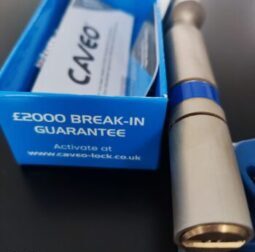
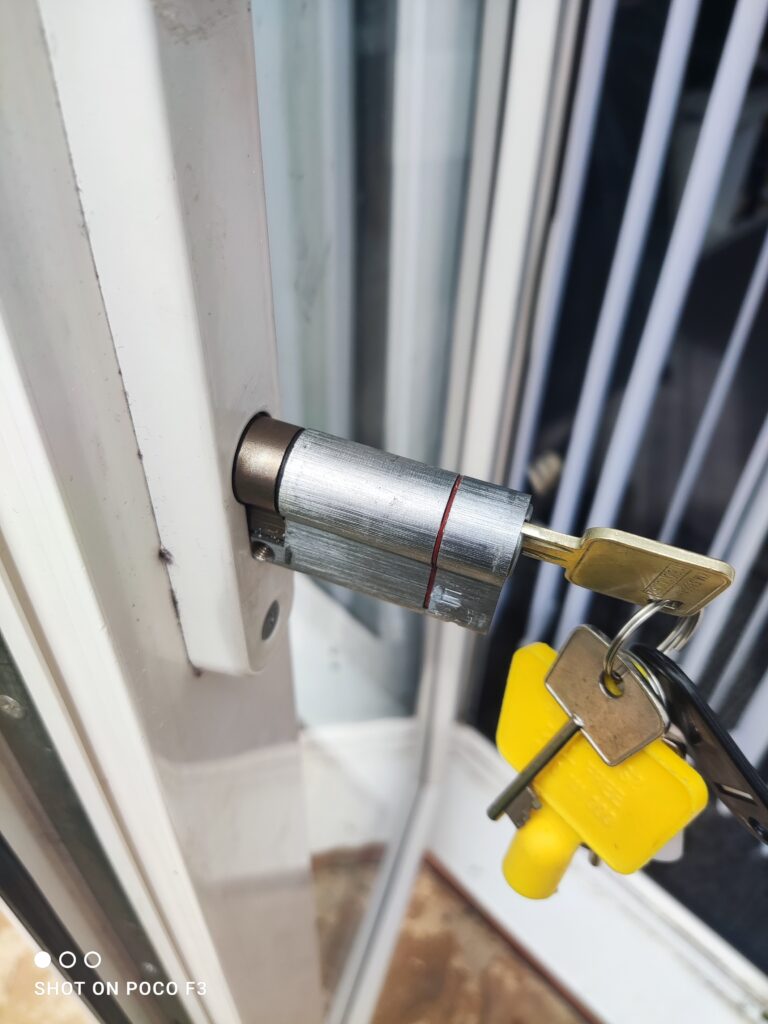
Cylinder offsets: Euro cylinders are measured in two independent halves from the central retaining screw hole to each outer edge (such as 35/45 mm). An external cylinder barrel should sit flush with the handle backplate, ideally protruding no more than 3 mm to minimise leverage points.
Varying Security Considerations Across Property Entrances
Different external access points present distinct physical requirements. Primary entrance doors handle high daily cycle rates, requiring robust latching and durable cylinders. Secondary timber doors, such as rear garden or utility entrances, often utilise five-lever mortice deadlocks.

Standards such as BS3621 and TS007 provide benchmarks for physical resistance. Research and academic publications on physical security While BS3621 is widely recognised for external timber door security, insurance terms vary between individual providers, making it advisable to check specific policy wording rather than assuming uniform rules. On composite and uPVC doors, installing TS007 3-star rated cylinders (or combining a 1-star cylinder with 2-star protective handles) provides tested defence against forced-entry techniques including cylinder snapping, drilling, and bumping.
Operational Changes That Signal Progressive Mechanical Strain
Door mechanisms rarely fail without prior warning symptoms. Paying attention to small changes in operational feel allows minor issues to be corrected before hardware becomes completely seized.
Key warning indicators include:
- Requiring firm body pressure against the door leaf to turn the key.
- A grating or clicking sound inside the door edge when depressing or lifting the handle.
- Visible metal dust or brass shavings around the cylinder plug.
- Latch bolts failing to spring back cleanly when handles are released.
Addressing these symptoms early through hinge adjustments, keep repositioning, or dry PTFE lubrication prevents sudden mechanical jamming.
Diagnostic Assistance for Kings Somborne Properties
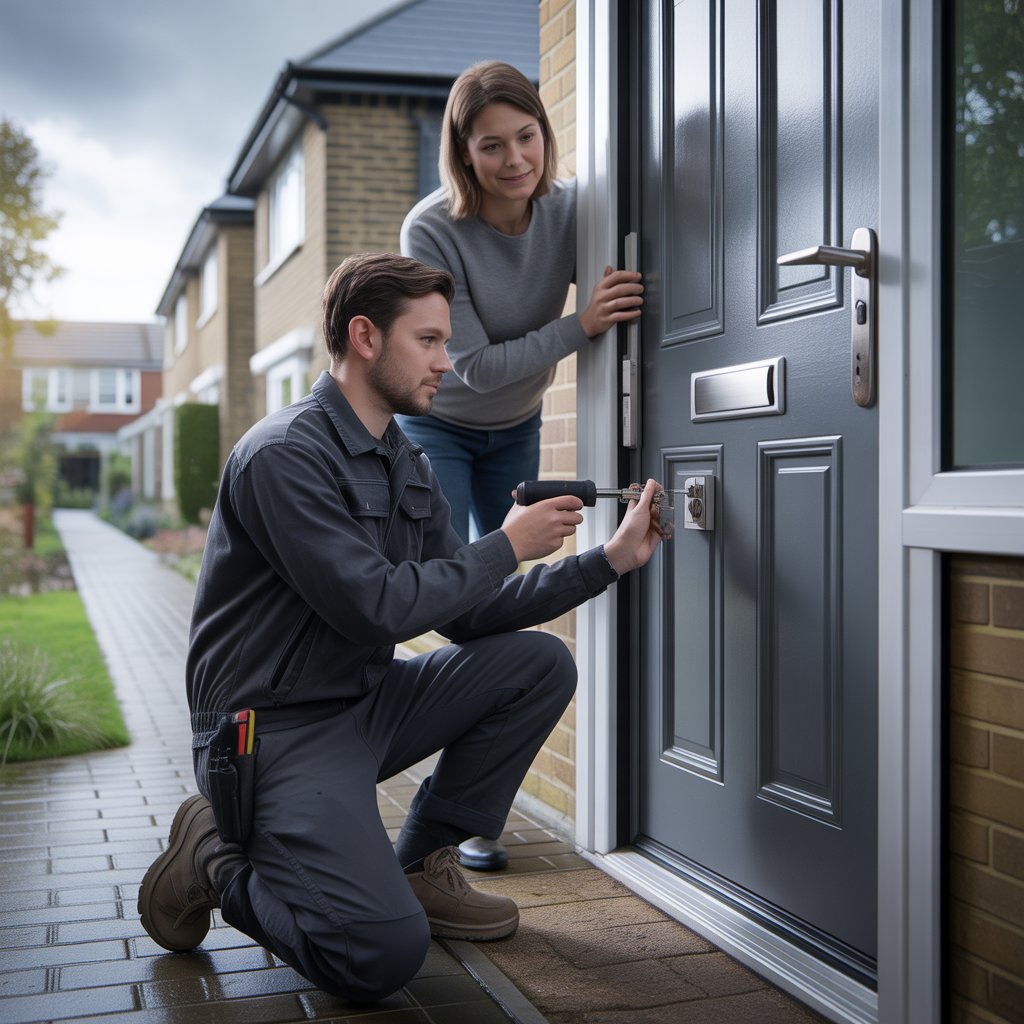
PIP Lockout provides independent mobile diagnostic evaluations and hardware installations across Kings Somborne and the wider Test Valley. Lead security engineer Phillip Aylen assesses the complete entrance assembly—verifying frame squareness, hinge condition, and internal gear wear—to determine whether mechanical adjustment, targeted servicing, or component replacement provides the most effective solution.
FAQs
Get in Touch Today
If you require immediate emergency access or wish to schedule a non-urgent security assessment for your Kings Somborne property, contact Phillip Aylen directly on 07391 815690.
Contact Locksmith Kings Somborne today for fast, professional, and reliable locksmith services you can trust.